Dr. Alisha Eisenberg·New·Calgary, AB
What is Cupping Therapy?
How suction lifts the fascia, what those marks actually mean, and why cupping pairs so well with acupuncture for tension, mobility, and recovery.
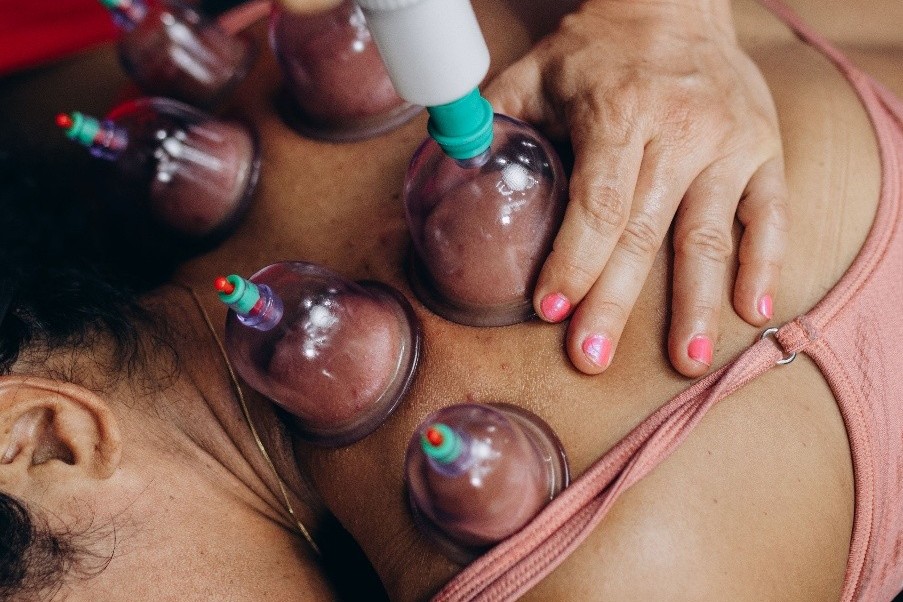
Understanding Cupping Therapy, Cupping therapy is a technique that uses specialized cups to create suction against the skin. Unlike massage, which applies pressure downward into the tissues, cupping gently lifts the skin, fascia, and underlying muscles upward. In Traditional Chinese Medicine, cupping is often used to move stagnant Qi and Blood, promote circulation, and help draw out excess conditions from the body.
Types of Cupping, There are two common styles of cupping. Static cupping involves placing cups in a specific area and leaving them in place for several minutes. Dynamic cupping, sometimes called moving cupping, involves gliding the cups across the skin using oil or lotion. Static cupping is often used to target specific areas of tension or stagnation, while dynamic cupping can address larger regions of tight or restricted tissue.
Understanding Cupping Marks, One of the most recognizable features of cupping is the marks it can leave behind. These marks are not bruises caused by tissue damage. In Traditional Chinese Medicine, practitioners often use the appearance of the marks as one piece of information when assessing the tissues. Common interpretations include bright red marks, often associated with Heat, inflammation, or an acute condition; dark red marks, which may suggest a greater degree of stagnation or congestion within the tissues; purple marks, traditionally associated with Blood stagnation and impaired circulation; deep purple or nearly black marks, often interpreted as significant or long-standing stagnation; and little to no marking, which can sometimes indicate a deficiency pattern where there is insufficient Qi and Blood available to create a strong surface response. In some cases, minimal marking may also suggest that there is very little stagnation present in the area.
Looking at the Bigger Picture, The colour and intensity of cupping marks are only one piece of the overall picture. An experienced practitioner will always consider your symptoms, health history, tongue, pulse, and other findings rather than relying on the marks alone.
Benefits of Cupping Therapy, Many patients notice reduced tension, improved mobility, and a sense of relief following treatment. Cupping is commonly used for neck and shoulder tension, back pain, headaches, sports recovery, and general muscle tightness.
Cupping and Acupuncture, Cupping can also be combined with acupuncture in the same treatment. In some cases, a cup may be placed over an acupuncture needle, creating both the stimulation of the acupuncture point and the lifting effect of the cup at the same time. This technique can be particularly useful when addressing stubborn areas of tension, restricted movement, or chronic pain.
Supporting Recovery and Healing, Whether used on its own or alongside acupuncture, cupping is a versatile treatment that can help improve circulation, reduce muscle tension, and support the body's natural healing processes.

About the Author
Dr. Alisha Eisenberg, R.Ac.
Alisha is a Registered Acupuncturist practicing in Calgary, Alberta. Her work focuses on chronic pain, mental health, women's health, and the quiet places where those things overlap. She practices out of Miceli Family Chiropractic in southeast Calgary, where she sees patients who are looking for a more thoughtful, root-cause approach to their care.
More About Alisha